 Permis Prêt
Work zone rules in Quebec: flaggers, orange signs and doubled fines
Three rules to know before you meet your first road work site.
Short answer: in a work zone, you obey the flagger even if a light or sign says otherwise. A speed limit on an orange sign is mandatory, just like one on a white sign. And the fine for speeding in a signed work zone is doubled.
1. The flagger outranks lights and signs
When a flagger (signaleur) is directing traffic during road work, everyone must follow their orders and signals, even against other signs or lights (Code de la sécurité routière, Quebec’s Highway Safety Code, s. 311). So if the light is green but the flagger signals you to stop, you stop. The same applies to a peace officer and a school crossing guard. Failing to comply carries 4 demerit points (Regulation respecting demerit points, Schedule, item 4).
The flagger uses a two-sided sign, sometimes a flag. According to the SAAQ guide Conduire un véhicule de promenade (Driving a Passenger Vehicle, ch. 4, “En présence d’un signaleur routier”):
- “Arrêt” (stop) side: stop and wait until the flagger waves you on;
- “Lentement” (slow) side: slow down, approach carefully and keep a good distance from the flagger.
Some sites use a traffic control gate operated remotely by a flagger. Facing its red light, stop at least 5 m away; go only when its yellow light flashes and the gate is up, at a reasonable speed (s. 359.0.1).
2. Orange means road work, and orange limits are mandatory
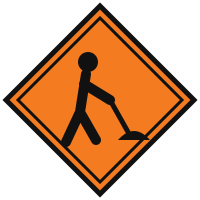
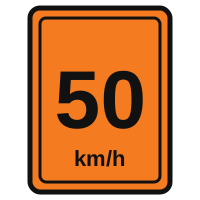
Road-work signs have an orange background, and a series of orange diamonds warns of a work site ahead (Guide de la route, ch. 3, “Signalisation de travaux”, and ch. 4, “À l’approche d’une zone de travaux”). During the work, whoever maintains the road may post a limit that differs from the usual one (s. 303.1), and no one may exceed it (s. 303.2). The handbook stresses that an orange speed limit sign is as binding as a white one, unlike the small yellow plate that only recommends a speed.
3. The fine is doubled
The Code sets the fine at double the base amount for speeding where a work-zone limit is posted (s. 516, second paragraph). The handbook puts it simply: any speeding in a signed road-work zone costs twice as much.
| You see… | You… |
|---|---|
| Orange diamonds | Slow down, be ready to change lanes or stop |
| Orange speed limit sign | Obey it: it is mandatory |
| Flagger showing “Arrêt” | Stop and wait for the signal |
| Green light, but the flagger says stop | Obey the flagger |
| Sign announcing a lane closure | Move into the open lane early |
Good habits
The SAAQ advises slowing down and leaving more room behind the vehicle ahead, watching for workers and equipment that may appear, and merging into the open lane as soon as the narrowing is announced rather than at the last moment (Guide de la route, ch. 4, “À l’approche d’une zone de travaux”). Patience is part of the job: the work is there to improve the road.
Key points for the test
- Flagger > lights and signs (s. 311).
- Limit on an orange sign = mandatory.
- Speeding in a signed work zone = doubled fine.
- Orange = road work; diamond = advance warning.
Original questions with an explanation and a source, “Road signs and signals” section.
Practise for free
See also
Official sources
- Code de la sécurité routière (Highway Safety Code, CQLR c. C-24.2), ss. 303.1, 303.2, 311, 359.0.1 and 516
- Regulation respecting demerit points (CQLR c. C-24.2, r. 37), Schedule, item 4
- SAAQ, Guide de la route (4th ed., 2024, French), ch. 3, “Signalisation de travaux”, “Limitation de vitesse”, “Signal avancé d’un signaleur”; ch. 4, “À l’approche d’une zone de travaux”
- SAAQ, Conduire un véhicule de promenade (2022), ch. 4, “En présence d’un signaleur routier”. English edition: Driving a Passenger Vehicle
General information page, current as of 2026-10-28. If in doubt, the official text prevails. Rules can change: check saaq.gouv.qc.ca and legisquebec.gouv.qc.ca.